
❄ Oral Sprays Science

Fast Acting Oral Sprays — Why Are They Effective

Behind every spray is science. FREEZE oral sprays utilise the oral mucosa for immediate absorption, bypassing the digestive system and first-pass hepatic metabolism. Below you will find the science behind their rapid action.

Oral spray absorption via the oral mucosa
1–5 minutesStart action
📊
50–90%Relative bioavailability
🔬
3 zonesMucosal absorption
📚
6+ referencesPubMed & EFSA
Mechanism of Action

Why do sprays work faster?;

Oral sprays are administered by spraying into the oral cavity. The active ingredients are absorbed directly by the oral mucosa—a thin, highly vascularised tissue—and enter the systemic circulation directly.

This bypasses both the gastrointestinal tract (which inactivates or delays many substances) and first-pass hepatic metabolism, which can dramatically reduce the bioavailability of oral formulations.

See all scientific references
  • Oral mucosa — thin, vascular, highly permeable.
  • First-pass bypass — more drastic in circulation.
  • Menthol & TRPM8 — permeation enhancer, increased mucosal permeability.
  • Phospholipids — bioavailability carriers for lipophilic substances.
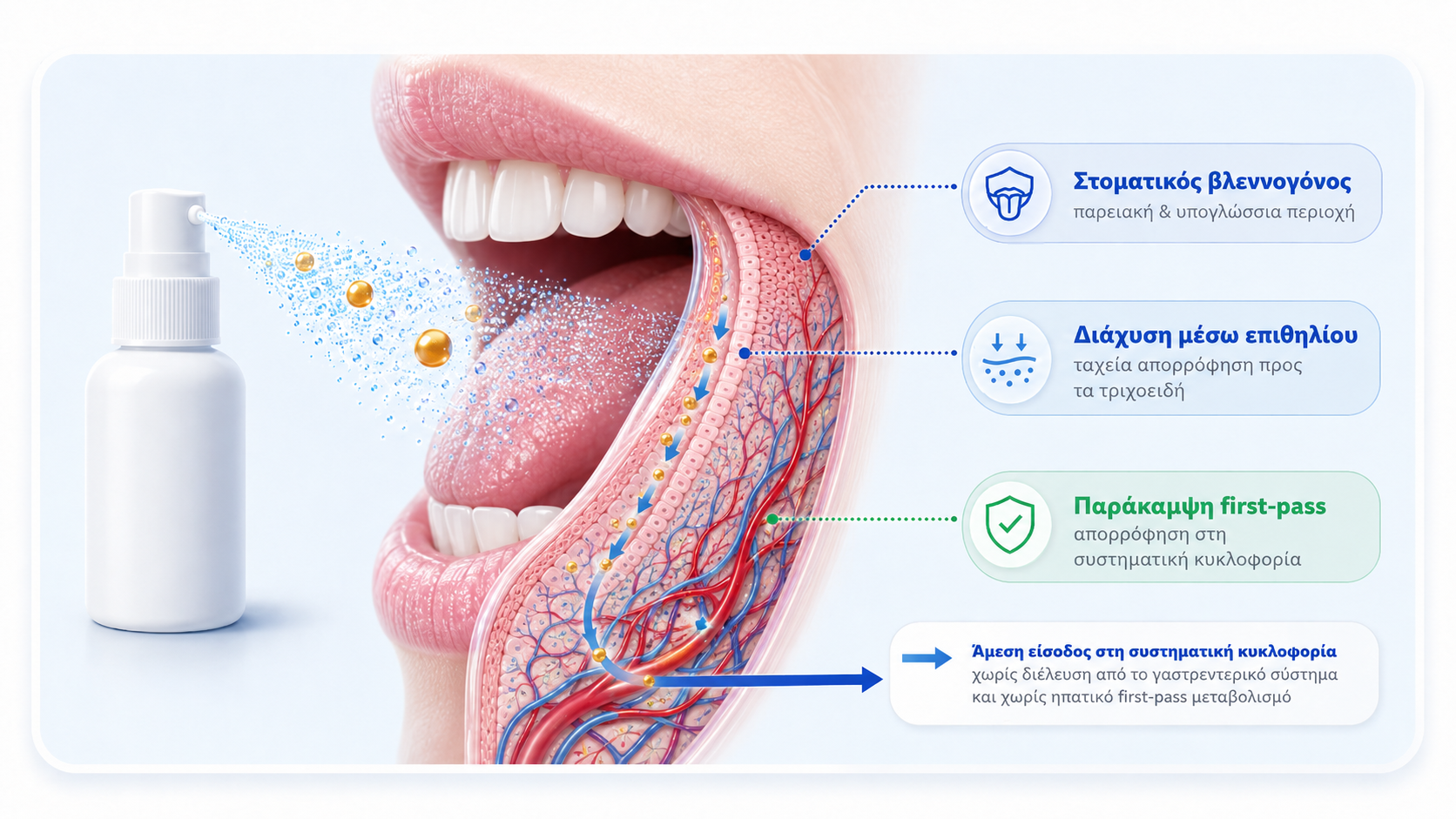
Oral spray absorption mechanism — oral mucosa, diffusion through epithelium, first-pass bypass
🔬
Mucosal absorption
Sublingual, parotid and submandibular gland
Max 1–5 minutes
30–90 minutes for tablets
📊
Bioavailability ~50–90%
It depends on the active ingredient and the formulation
📚
PubMed and EFSA sources
Public, verifiable reports
Bioavailability

Comparison of Administration Routes

The plasma concentration kinetics show why oral sprays stand out.

Plasma Concentration by Route of Administration
Kinetic absorption versus time (hours)
Oral Spray (FREEZE)
Intravenous (mention)
Tablet
100% 80% 60% 40% 20% 0 1 2 3 4 5 6 hours ~85% · 1 hour
Grant StreetBioavailability (F)Start Action
Oral spray (sublingual) FREEZE~50–90%*1–5 minutes
Intravenous (IV) Report100%Immediate
Oral tablet Conventional~5–20%*30–90 minutes

Note: The above figures represent ranges of values from the literature for different active substances. The exact bioavailability depends on the chemistry of each ingredient, the formulation and the route of administration.

Absorption Anatomy

Three Mucosal Zones in the Mouth

The oral cavity offers three different absorption areas. FREEZE sprays were designed to primarily utilise the sublingual and buccal zones.

Sublingual area — the fastest
Rich blood supply, thin mucosa, rapid absorption into the systemic circulation. The prime zone for FREEZE oral sprays — spray under the tongue for the fastest action.
Capital zone FREEZE
Buccal mucosa
Large surface area
Large surface area and good blood supply. Suitable for larger molecules or formulations that require a slightly prolonged contact time. Spray onto the inner cheeks.
Secondary zone
Soft palate
Supplementary belt
Thin mucous membrane with a rich vascular network. Contributes to overall mucosal absorption and spray dispersion within the cavity.
Supplementary belt
Use and Outcome

How, Why and What to Expect

Three basic questions that the science of oral sprays answers.

1

Spraying

Under the tongue, on the cheeks or on the palate

2

Absorption

Direct passive diffusion through vascular endothelium

3

Traffic

Without a digestive system, without first-pass effect

4

Quick action

Max time 1-5 minutes instead of 30-90 minutes

Up to 6-90x faster than tablet

USER INSTRUCTIONS FOR OPTIMAL ABSORPTION

💧
Spray on sublingual region or on the inside of the cheeks
Keep the spray for 20–30 seconds before you swallow
🚫
Do not eat or drink for 10–15 minutes after use
🌅
Make use daily ritual — the result improves with consistency

Targeted absorption – where it counts

The oral mucosa is the most effective pathway — thin, rich in blood vessels, and without the barriers of the digestive system.

  • 1 Spray droplets
  • 2 Vascular mucosa
  • 3 Immediate release
Conclusion and FREEZE Promise
Oral sprays are an effective alternative route of administration, with rapid onset of action and higher bioavailability compared to conventional oral formulations. 30+ oral sprays — designed in Greece, with selected active ingredients of high bioavailability.
VIEW THE FULL SERIES
Bypass of digestive & hepatic first-pass metabolism
Action on 1–5 minutes
Bioavailability up to ~90% for selected substances
Easy, non-invasive administration
Bibliography

Scientific Reports

Public, verifiable reports from PubMed and EFSA.

1
Strategies to modify drug release from pharmaceutical systems
Bruschi, M. L. (2015). Woodhead Publishing.
Pharmaceutical
PubMed ↗
2
Intranasal delivery: physicochemical and therapeutic aspects
Costantino HR et al. Int. Journal of Pharmaceutics, 337(1–2), 1–24. (2007)
REVIEWTransmucosal
PubMed ↗
3
Factors influencing drug release from transmucosal drug delivery systems
Dhakar RC et al. Webmed Central Pharmaceutics, 2(1). (2011)
REVIEW
PubMed ↗
4
Buccal mucosa as a route for systemic drug delivery: a review
Shojaei AH. Journal of Pharmacy & Pharmaceutical Sciences, 1(1), 15–30. (1998)
REVIEWBuccal
PubMed ↗
5
Transport of drugs from the nasal cavity to the central nervous system
Illum L. European Journal of Pharmaceutical Sciences, 11(1), 1–18. (2000)
Pharmacokinetics
PubMed ↗
6
Current status and the future of buccal drug delivery systems
Pather SI et al. Expert Opinion on Drug Delivery, 5(5), 531–542. (2008)
REVIEWBuccal
PubMed ↗